Buying guide
Pour-over guide: technique, kettles and scales
Cone shapes, filters, kettles and a starting recipe.
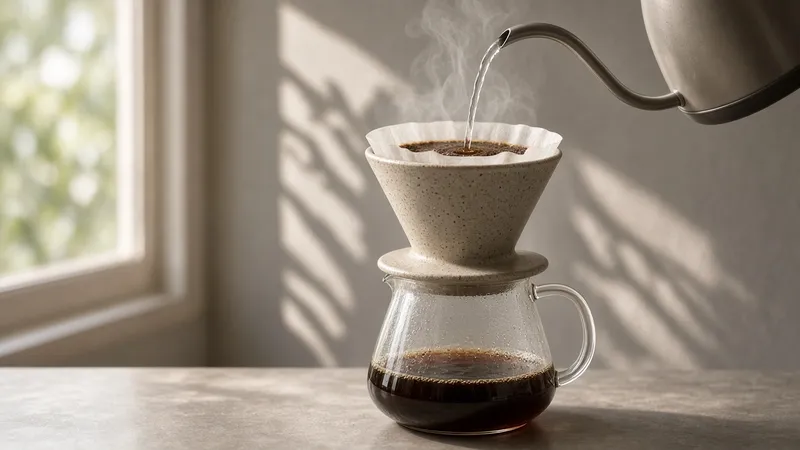
Follow the NCA pour-over starting range of 1:13–1:16, at 93 ± 3°C, with about 2–4 minutes of contact. Wet the whole bed, bloom, then pour evenly. A kettle and scale help only when they fit a repeatable technique.
- Filter shape and material change the water path.
- A controllable pour matters more than a decorative kettle.
- A scale must suit both vessel weight and useful resolution.
Why pour-over
Pour-over coffee is brewed by pouring hot water over grounds in a cone or flat-bottomed dripper, where it filters through into a cup or carafe. Because you control the water flow, temperature and timing, pour-over gives a lot of control over the result. It tends to produce a clean, clear cup with distinct flavors, especially with paper filters.
The trade-off is attention. Pour-over takes a few minutes of active work, and small changes in grind or pour can change the taste. That's also why it's popular with people who enjoy adjusting a recipe.
Drippers compared
| Dripper style | Examples of the style | Flow | Notes |
|---|---|---|---|
| Cone, single large hole | V60-style | Fast; pour technique matters | Sensitive to grind and pour |
| Flat bottom, small holes | Kalita Wave-style | Steadier | More forgiving |
| Thick-filter carafe | Chemex-style | Slower | Very clean cup, larger batches |
| Immersion-hybrid | Clever-style drippers | Steeps, then drains | Easy and consistent |
Each dripper has its own filter shape, so buy filters that match. Materials range from plastic to ceramic, glass and metal. Ceramic holds heat well if preheated, and plastic is light and holds heat surprisingly well too.
Step-by-step recipe
The NCA pour-over method gives 93 ± 3°C water, a 1:13–1:16 coffee-to-water range, a bloom using double the coffee mass in water, a 30–45 second bloom wait, and about 2–4 minutes of contact. Those are starting conditions for this guide.
- Fit and rinse the correct filter; discard the rinse water.
- For an illustrative 1:16 calculation, weigh 20 g coffee and plan 320 g total brew water. These masses are arithmetic within the NCA range.
- Add and level the medium grounds. Start the timer and wet the bed with 40 g water, calculated as twice that dry dose.
- Wait through the bloom, then add water slowly and evenly to the total.
- Let the bed drain, remove the dripper, mix the beverage gently and taste after cooling.
Keep the water stream off bare paper where possible. If dry clumps remain, improve the initial wetting instead of pouring ever more water through an uneven bed.
Troubleshooting
Taste tells you what to change. Change one thing at a time.
| What you taste or see | Likely cause | Try |
|---|---|---|
| Sour, thin | Under-extracted | Grind finer, hotter water, slower pour |
| Bitter, dry | Over-extracted | Grind coarser, shorter brew |
| Weak but balanced | Ratio too low | More coffee using a recorded stronger ratio |
| Too strong | Ratio too high | Less coffee, or dilute |
| Drains very slowly | Grind too fine or clogged filter | Coarser grind, fewer fines |
| Uneven bed after brewing | Uneven pouring | Pour gently in the center, swirl |
See Coffee-to-water ratios by method and Grind size by brew method.
Water, beans and freshness
Pour-over shows off the coffee itself, so the beans and water matter a lot. Freshly roasted coffee releases carbon dioxide; ask the roaster about resting that particular coffee rather than applying a universal peak date. That's also why fresh coffee blooms so dramatically. Buy whole beans with a roast date on the bag and grind right before brewing.
Water makes up most of the cup. Water that tastes bad on its own will make coffee that tastes bad. Very hard water can mute flavors and build scale in kettles, while very soft or distilled water can taste flat and extract poorly. Many home brewers use filtered tap water. See Water for coffee: why it matters for more detail.
Roast level changes the recipe a bit too. Light roasts tend to need hotter water and a slightly finer grind to extract fully. Dark roasts extract more easily and can turn bitter with very hot water, so some people lower the temperature a few degrees.
Reading the drawdown
Drawdown is the time it takes for the water to finish draining through the coffee bed after your last pour. It's one of the most useful signals in pour-over. Compare total contact with the NCA starting window given above, while allowing for the chosen dripper and dose.
If the drawdown is much slower than the recipe expects, the grind is probably too fine, there are a lot of fines, or the bed is clogged from heavy agitation. The cup may taste bitter or dry. If it drains much faster, the grind is likely too coarse and the cup may taste thin or sour.
Look at the spent coffee bed too. A flat bed suggests even extraction. A steep cone or coffee stuck high on the filter walls can mean uneven pouring. Change one variable at a time and keep notes so you can repeat a cup you like.
Care and safety
- Rinse drippers after each use and wash with mild soap regularly.
- Descale kettles as the manual says.
- Pour slowly and keep the dripper steady. Near-boiling water can cause burns.
Temperature control versus stovetop
Electric kettles with hold modes repeat brew temps without a thermometer. Stovetop goosenecks need a probe or careful timing off boil.
The Stagg EKG Pro description, for example, distinguishes a temperature setting from a hold mode. Check the functions you would actually use, not just the presence of a display.
Use the NCA temperature in the brewing method above.
Capacity, balance and materials
Choose enough usable capacity for your recipe plus any filter rinse. Heavier bases tip less when full. Stainless interiors are common; check lid security.
Pour balance matters as much as electronics — test whether you can hold a slow spiral comfortably.
When not to buy
If you only drink batch drip or capsules, a gooseneck is optional. Put budget into the grinder first — Building a first coffee kit: grinder, brewer and upgrades.
Why weight beats scoops
Roast level and grind change how much mass fits in a spoon. Grams stay stable. That is why ratio guides prefer a scale once you care about repeats.
National Coffee Association brewing education emphasizes process control; weighing is the simplest home control after grind evenness.
Scale resolution, placement and tare
The Hario V60 Drip Scale specification states a 2,000 g maximum. Its intervals change with load: 0.1 g at 2–200 g, 0.5 g at 200–500 g, and 1 g at 500–2,000 g. The weight of the server counts toward the load, so do not describe this as constant precision throughout its range.
Check platform size and display visibility with your actual dripper or cup in place. The same page says the scale is not water resistant. Keep it away from the steam wand and wipe it dry; a timer does not make its electronics waterproof. Use manual tare while learning so an unexpected automatic reset cannot hide how much water you already added.
Place it on a firm counter, tare the empty vessel, add the dry dose, then tare before adding brew water. A soft mat or a vessel touching the surrounding counter can interfere with the reading. Check this simple setup before blaming the recipe.
When a scale will not save the cup
Uneven grinding still produces muddy or split-flavored cups at perfect ratios. Fix burr quality before buying a second scale.
If you only brew casual immersion without notes, a scale is still useful but not urgent compared with replacing a blade mill.
FAQ
Why bloom the coffee?
Fresh coffee releases carbon dioxide when hot water hits it. Blooming lets that gas escape so water can extract the grounds more evenly afterward.
Paper, metal or cloth filters?
Paper filters remove more oils and fine particles for a cleaner cup. Metal filters let more oils through for a fuller body. Cloth sits in between and needs careful cleaning.
Should I rinse paper filters?
Many brewers rinse paper filters with hot water to remove paper taste and preheat the dripper. Discard the rinse water.
Next step
For Pour-over guide: technique, kettles and scales, compare bands on tiers or run the matcher once.
Sources
Spec notes for Pour-over guide: technique, kettles and scales are compiled from maker docs and public references — not a hands-on review. Confirm live specs before buying.