
Explainer
Grind size by brew method
Which grind ranges each method needs, and what that means for grinder specs.
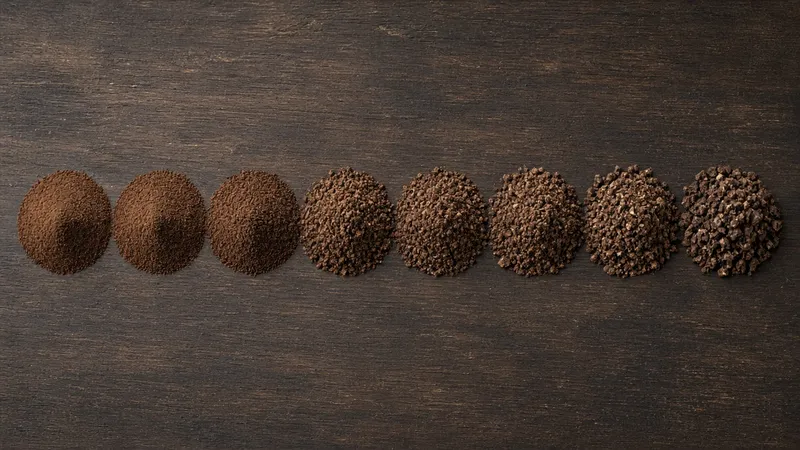
Match grind size to how long water touches the coffee. Short contact needs fine grounds (espresso), medium contact needs medium grounds (drip and pour-over), and long contact needs coarse grounds (French press, cold brew). Grind settings differ between grinders, so treat any chart as a starting point and adjust by taste: grind finer if coffee is sour or weak, coarser if it's bitter or harsh.
- Finer grinds extract faster; coarser grinds extract slower.
- Short contact time (espresso) needs fine grind; long contact (French press, cold brew) needs coarse.
- Espresso needs a grinder with fine, precise adjustment.
Why grind size matters
Grinding increases the coffee's surface area. Finer grounds have more surface area, so water extracts flavor faster. Coarser grounds extract more slowly. Each brew method has a contact time between water and coffee, and grind size is matched to that time so the coffee extracts properly.
Get it wrong in one direction and you under-extract, which tastes sour, thin and sometimes salty. Get it wrong in the other and you over-extract, which tastes bitter, dry and harsh. Grind is an important extraction control, but water distribution and contact matter too.
Grind chart by method
The NCA grind chart identifies coarse grounds for French press and cold brew, medium for drip and pour-over, and fine for espresso. These are starting categories, not measurements that transfer between grinders.
| Method | Starting texture | What to watch |
|---|---|---|
| Espresso | Fine | Flow and beverage yield; tiny changes matter |
| Moka | Moka-appropriate medium-fine | Unrestricted flow without tamping |
| AeroPress | Recipe-dependent | Gentle press without excessive resistance |
| Pour-over / drip | Medium | Even saturation and drainage |
| French press | Coarse | Sediment and plunger resistance |
| Cold brew | Coarse | Complete wetting and filtration |
Turkish coffee requires its own very fine grinding path; do not assume every burr grinder covers it. Texture analogies such as salt or sand are descriptive cues only. Bean brittleness, burr condition and recipe all change the result.
Grinder quality and consistency
Burr grinders produce more even particle sizes than blade grinders. With a blade grinder, the same coffee contains dust and chunks, which extract at very different rates. That makes it hard to match grind to method. See Coffee grinder buying guide: burrs, blades and method fit.
Espresso needs the finest and most precise control. Filter methods are more forgiving, and an entry-level burr grinder can do well.
Worked scenarios
Muddy French press: check whether fines are passing through the screen. Coarsen gently and let the coffee settle before pouring; also inspect whether the screen is assembled properly.
Fast, sharp pour-over: compare the drawdown with your chosen recipe. A coarser bed can drain quickly, but water bypassing the coffee can look similar. Check pouring and filter fit before assuming the grind is solely responsible.
Espresso runs quickly: hold the dry dose and beverage target steady, then try a finer setting. A tilted tamp or channel through the puck can produce a fast uneven shot even with fine grounds.
New roast: begin near the previous setting, record what changed, and retune. Do not assign a universal grinder number to “light roast.”
Common mistakes
- Using one grind for every method.
- Trusting grinder numbers across brands.
- Changing ratio to fix extraction problems. See Coffee-to-water ratios by method.
- Grinding far ahead of time.
- Ignoring roast level.
Why particle consistency matters as much as size
When people talk about grind size, they usually mean the average particle size. But every grinder produces a range of particles, from fine dust (fines) to larger pieces (boulders). The width of that range affects taste as much as the average.
Imagine a pour-over where most particles are the right size, but there's also a lot of dust and some big chunks. The dust extracts very fast and can add bitterness. It can also clog the filter and slow drainage. The chunks extract slowly and add sourness. The result can taste both sour and bitter at once, which is confusing to fix. A more consistent grinder narrows that range, so the coffee tastes more balanced and changes to the grind setting have clearer effects.
This is why blade grinders are hard to dial in. They produce a very wide range of particle sizes. It's also why some home brewers sift out fines with a fine mesh sieve, although that's an extra step most people skip. For most people, a decent burr grinder is the biggest single improvement, more than an expensive brewer.
Dialing in, step by step
Dialing in means adjusting the grind until a brew tastes right. Keep the dose, water amount and technique the same while you change only the grind.
Start with the recommended setting for your method. Taste the coffee. If it's sour, sharp or thin, grind finer. If it's bitter, harsh or drying, grind coarser. Make small changes, a step or two on most grinders, and brew again.
Writing down the setting, dose, brew time and a few words about taste helps a lot, because grinder numbers aren't the same across brands. Once you find a setting you like for one coffee, a new bag usually needs only a small adjustment. Grinder settings can also drift as burrs wear, so check now and then.
Grinding for more than one method
If one grinder serves both espresso and filter, switching between very fine and coarse settings can take a few purge grinds to clear old grounds. Some people keep separate grinders for this reason.
Care
- Clean the grinder regularly so old grounds and oils don't affect taste.
- Keep beans airtight and away from light and heat. See Coffee freshness and storage.
FAQ
Can I use one grind for everything?
You can, but results suffer. A medium grind in a French press can taste muddy and bitter, and in espresso it runs too fast and tastes sour.
Why do grinder settings not match between brands?
Each grinder's numbering is arbitrary. 'Setting 15' on one grinder isn't the same as on another. Start with the maker's suggestions and adjust.
What are fines?
Very small particles produced by all grinders. They extract quickly and can add bitterness and slow drainage. Better grinders produce fewer fines.
Does roast level change the grind?
Often. Light roasts are denser and may need a finer grind to extract well. Dark roasts extract more easily and can go a bit coarser.
Next step
After Grind size by brew method, skim the glossary or the hub index.
Sources
Spec notes for Grind size by brew method are compiled from maker docs and public references — not a hands-on review. Confirm live specs before buying.