Buying guide
Building a first coffee kit: grinder, brewer and upgrades
Why many coffee references prioritize the grinder.
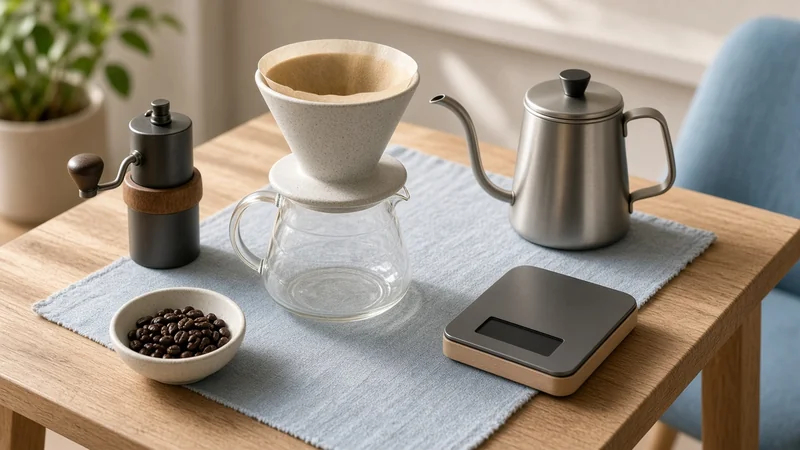
- For filter coffee, the brewer can be simple and inexpensive.
- For espresso, both grinder and machine matter, and the grinder is often underbudgeted.
- Hand grinders deliver burr consistency at lower cost.
Grind quality multiplies every brewer
Uneven particles under- and over-extract in the same cup. A capable burr grinder improves drip, press, pour-over and espresso more reliably than upgrading the brewer while keeping a blade mill.
Many specialty educators suggest putting more of a starter filter budget into grinding than into the brewing vessel. Espresso raises the requirement again because fine settings need resolution.
Roles: the grinder sets particle distribution; the brewer manages water path and time.
Starter splits by method
Filter-only: prioritize even burrs, then thermal drip or a simple cone; add scale and kettle next.
Espresso-oriented: avoid a shiny machine paired with a weak grinder. Entry semi-autos with capable grinders beat expensive machines fed inconsistent fines.
Capsule and super-auto paths buy convenience — compare tradeoffs in capsule vs super-automatic.
When the brewer upgrade is justified
If grinding is already even and coffee tastes baked on a hot plate, move to a thermal carafe drip machine.
If pour-overs suffer from chaotic pouring, a gooseneck with temperature hold helps more than a third dripper shape.
If espresso swings wildly on a pressurized basket and blade grind, fix grinding before dual boilers.
Midrange spending traps
Two mediocre grinders can cost more than one stronger dual-use unit unless workflow truly needs separation.
Redundant frothers and scales clutter small counters — see Shared coffee setups: households, small kitchens and offices.
Integrated grinders that are hard to service hide long-term cost.
A purchasing sequence that stays sane
Pick the primary method, buy the matching burr grinder, buy the brewer, add a scale, then add kettle or frother only if needed.
Use the brew matcher to map method and budget band, then read specs on deals and tiers.
Budget also for filters, cleaner and gaskets — consumables keep gear tasting sweet.
Skill closes gaps spend cannot
Weighing, dialing grind and cleaning often improve cups more than another upgrade cycle.
Track which cups you like. Upgrade the blocker for those cups, not the viral gadget of the week.
Mixed households may need two brew paths — Shared coffee setups: households, small kitchens and offices.
Where midrange money usually helps
Better burr sets and adjustment, thermal carafes, temperature-hold kettles, espresso machines with more usable steam or temp control, and scales that fit the brewing workflow.
Midrange is wasted when paired with blade grinding.
Scenario builds
Filter weekday: entry burr + thermal drip or cone. Enthusiast filter: better grinder + gooseneck + scale. Espresso: do not strand midrange machine money without espresso-capable grinding — Beginner espresso: setup, dial-in and milk workflow.
Consumables and longevity
Factor filters, cleaner, replacement burrs and gaskets. A cheap tool that cannot be serviced may cost more over years.
Minimum viable kit
Burr grinder + brewer + scale covers most paths. Add a kettle for pour-over and a frother only if milk drinks matter.
Read budget split before spending on chrome.
Skills before upgrades
Weigh coffee and water, log grind settings, clean gear weekly. Those habits beat early upgrades.
NCA and SCA educational pages outline brew fundamentals — NCA how to brew, SCA standards.
When to expand the kit
Add tools only to fix a repeated fault (uneven pours → gooseneck; baked drip → thermal carafe; travel → hand grinder).
Make the comparison before buying an upgrade
Write down the defect you want to fix and the current kit. “Better coffee” is too vague to guide a purchase. “The basket overflows at the household batch size,” “the grinder cannot make small enough espresso changes” and “the last cup tastes cooked” each point to different hardware. Clean and check the existing equipment before deciding it is intrinsically incapable.
For a filter drinker using a blade mill, burr adjustment addresses a problem a decorative dripper cannot. For someone already making evenly ground coffee, a thermal server may solve holding quality without replacing the brewer. For an espresso owner whose machine grinds internally, do not add a standalone grinder by default. First identify an actual limit in adjustment or workflow.
Build complete paths rather than mismatched collections
A manual-filter path needs a dripper or immersion brewer, matching filters if required, a safe hot-water source and suitable coffee. A pump-espresso path also needs compatible dosing and tamping tools and a grinding solution appropriate to its basket. Capsule machines and bean-to-cup machines solve grinding in different ways and should not receive the same accessory shopping list.
Count storage, cleaning supplies and replacement consumables as part of the setup. A machine with an obscure proprietary filter may be less convenient than a simpler system with supplies available locally. Check the support route in your region and avoid importing a voltage-mismatched appliance because its feature list looks attractive.
Decide when to stop
Keep the first kit stable long enough to learn what each control does. Use the same coffee and water while changing grind, and preserve a recipe you like before experimenting again. A satisfying repeatable weekday cup is a valid endpoint, not merely a temporary stage before premium gear.
Upgrade when the routine exposes a specific recurring constraint: hand grinding large batches is tiring, milk drinks queue behind a heater transition, or a shared counter cannot support separate appliances. These are workflow requirements. Buying around an imagined future hobby tends to create redundant tools that do not improve the drink you actually make.
FAQ
Must the grinder always cost more?
Common heuristic for filter kits, not a law. Espresso needs both a workable machine path and fine grinding.
Hand grinder first?
Valid for one or two cups. Electric wins for large daily batches.
I already own drip — what next?
Upgrade off blades or a worn cheap burr set.
Do built-in grinders count toward grinder budget?
Yes. Judge adjustment quality as carefully as standalone units.
Next step
For Building a first coffee kit: grinder, brewer and upgrades, compare bands on tiers or run the matcher once.
Spec notes for Building a first coffee kit: grinder, brewer and upgrades are compiled from maker docs and public references — not a hands-on review. Confirm live specs before buying.