
Explainer
Coffee-to-water ratios by method
Starting ratios and how to scale them.
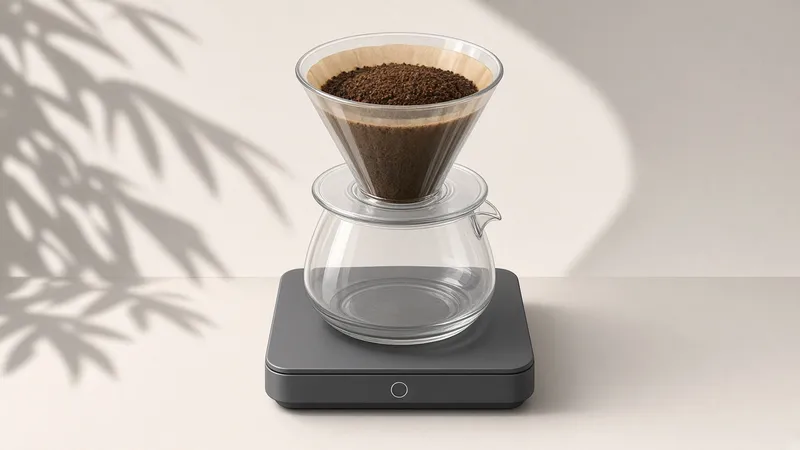
For starting recipes, NCA gives pour-over at 1:13–1:16, French press at 1:10–1:16, cold-brew concentrate at 1:4–1:5, and espresso at 1:2 dry dose to beverage yield. These ratios describe different methods and are not interchangeable.
- Filter ratios count water added; espresso ratios count the drink collected.
- Set strength with ratio, then diagnose extraction with grind and technique.
- A scale turns a liked cup into a repeatable recipe.
What the ratio controls
The coffee-to-water ratio describes how much coffee is used relative to water. It influences strength, while grind, contact, agitation and water temperature also affect extraction. Those controls interact, so strength and extraction are related rather than perfectly independent knobs.
The SCA article Towards a New Brewing Chart defines total dissolved solids as brew strength and extraction yield as the fraction of grounds moved into the liquid. It also cautions against a one-size-fits-all ideal region. You do not need a refractometer to ask whether the drink is too intense, too weak, or unevenly extracted.
A balanced but watery cup suggests a strength adjustment. A harsh, sharp or drying cup deserves investigation of extraction and technique. Taste is a clue, not a laboratory diagnosis: roast character and channeling can complicate a simple sour-versus-bitter rule.
Starting ratios by brew method
These are the numbers on the specific NCA method pages, not a universal Golden Cup prescription. Choose a recipe appropriate to the brewer and use its measurement convention.
| Method | NCA starting ratio | Measurement |
|---|---|---|
| Pour-over | 1:13–1:16 | Coffee to water added |
| French press | 1:10–1:16 | Coffee to water added |
| Cold concentrate | 1:4–1:5 | Before serving dilution |
| Espresso | 1:2 | Dry dose to liquid beverage |
For automatic drip and AeroPress, follow the machine or recipe instructions rather than borrowing a concentrate ratio. Cup markings and scoops measure different things from grams. There is no reliable universal tablespoon-to-gram conversion across roast levels and grind sizes.
How to dial in your ratio
- Choose a documented method recipe. An illustrative pour-over calculation at 1:16 is 20 g coffee with 320 g water; this is arithmetic from the NCA range, not an externally tested recipe.
- Use the same beans, grinder setting, water and pouring or stirring routine.
- Taste the finished drink at a comfortable temperature. Decide whether intensity or an unpleasant flavor is the main problem.
- Change only the part of the recipe that addresses that problem, then compare.
- Record what changed and preserve the recipe you like.
If you change grind and ratio at once, the result may improve, but you have not learned which adjustment helped. A simple written baseline is more useful than a long set of unrepeatable experiments.
Worked examples
Scale a chosen recipe: doubling the illustrative 20 g / 320 g pour-over gives 40 g / 640 g. The ratio is unchanged, but the deeper coffee bed can alter flow. Check capacity and drainage rather than promising that total brew time remains identical.
Check an automatic brewer: measure the actual water for the batch you want, then apply the maker’s dosing instructions. Check the basket limit before adding grounds. A label saying “cups” is not enough to establish either dose or useful mug count.
Espresso: the NCA 1:2 ratio means liquid espresso, not reservoir water. Using the 18 g dose described for the Breville Bambino gives a calculated 36 g beverage. That example is not a dosing prescription for another basket.
Concentrate: keep the brew record separate from the serving record. If you dilute cold concentrate in the cup, write down what was added there so a watery serving is not mistaken for a weak extraction.
Choosing a scale and kettle for repeatable ratios
A scale needs to support the filled vessel without hiding its display. Tare the empty cup or server, add the grounds if appropriate, then reset for the water measurement. A timer helps relate pouring and contact to the chosen method. Platform clearance matters more than connectivity.
A controllable kettle is useful for pour-over but less important when water is added for immersion. Temperature control reduces a variable; it cannot compensate for an unsuitable grind or poor wetting. Keep the scale dry and do not put a hot kettle directly on it unless its instructions permit that use.
Buyer scenarios
Weekday batch: measure the useful reservoir fill and the matching dose once, then make that pairing easy to repeat. Keep the written instructions near the machine for anyone sharing it.
Recipe experiments: compare adjacent strengths with the same coffee and grind, using the documented method range as the starting point. Do not assume that the strongest cup is the most extracted.
Cold-brew service: make the concentrate with the Cold brew: methods and gear and adjust serving dilution independently. Adding milk or melting ice changes the finished drink, so evaluate it in the form you actually drink.
Common mistakes
- Assuming a scoop always holds the same coffee mass.
- Mixing water-in filter ratios with beverage-out espresso ratios.
- Ignoring water retained by spent grounds when planning servings.
- Using more grounds than a basket can accommodate safely.
- Changing several variables, then crediting the ratio for the whole result.
- Blaming ratios when off-tasting water or dirty gear is the underlying problem.
For iced hot-brewed coffee, use a published iced recipe and account for melting ice rather than calling it cold brew. The extraction process differs even when both drinks end up cold.
Care and safety
- Descale kettles and drip machines on the schedule in their manuals. Mineral buildup affects temperature and flow.
- Keep the scale away from hot spills and water. Many aren't waterproof.
- Pour hot water slowly and keep handles turned away from the counter edge. Water near boiling can cause serious burns.
FAQ
Why use water in for filter coffee?
It is the practical recipe input you can weigh. The beverage will be lighter because grounds retain liquid.
Why use liquid out for espresso?
Reservoir water also goes through paths that do not become the drink. Beverage yield makes the shot recipe directly observable.
Does a stronger cup have more caffeine?
Taste strength does not establish a measured caffeine dose. Beans, extraction and serving size matter; this site does not measure caffeine.
Next step
After Coffee-to-water ratios by method, skim the glossary or the hub index.
Sources
Spec notes for Coffee-to-water ratios by method are compiled from maker docs and public references — not a hands-on review. Confirm live specs before buying.