
Pour-over vs French press
Paper-filtered percolation versus full immersion with a mesh plunger.
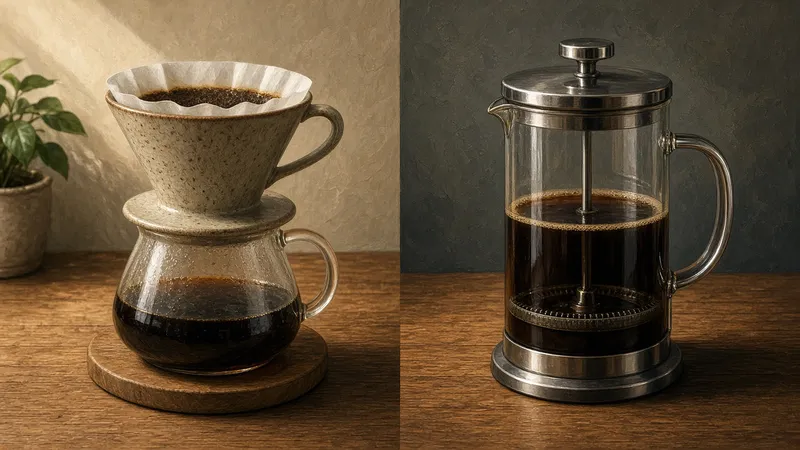
At a glance
| Pour-over | French press | |
|---|---|---|
| Water path | Hand-poured percolation | Full immersion followed by separation |
| NCA ratio range | 1:13–1:16 coffee to water | 1:10–1:16 coffee to water |
| NCA contact cue | 2–4 minutes | Approximately 4 minutes |
| Common filtration | Paper; optional metal or cloth | Metal mesh |
| Serving discipline | Remove dripper after draining | Decant brewed coffee off the grounds |
Choose pour-over if…
- You want clarity and aroma over weight
- You enjoy a short pouring ritual
- You already own or want a gooseneck
Choose french press if…
- You want a heavier cup with less pour technique
- You brew immersion batches for two
- You prefer a single vessel without paper filters
Filter and immersion solve different preferences
Paper pour-over retains more oils and particles, while a mesh press lets more through. Choose the clean texture of paper if sediment bothers you. Choose immersion if you enjoy a fuller cup and want to add water without managing a spiral pour. Neither preference proves the other method extracted badly.
Use the method’s own recipe
The NCA pour-over guide gives a 1:13–1:16 starting ratio and 2–4 minutes of contact. Its French-press guide gives 1:10–1:16 and about four minutes. These are separate starting ranges, not a reason to impose identical grind and timing on both.
Pour-over needs even initial wetting and a controlled water path. The press needs a sound screen and a gentle plunge, followed by decanting. Press resistance or grit calls for inspecting grind and assembly, not pressing harder.
The cleanup difference at the sink
With paper, lift the spent filter and grounds out together. With a press, wet grounds remain in the carafe and around the screen assembly. If nobody will disassemble and wash that screen, a simple paper dripper may fit better despite requiring more attention during brewing.
Pour-over trades technique for clarity; French press trades sediment management for immersion body. Neither needs espresso pressure.
Sources
Side-by-side reading of published specs and category norms — not a lab bake-off.
Related: brew matcher · tiers · all comparisons